FICA payroll taxes: the 7.65% on every US paycheck, explained
FICA breaks down to 6.2% Social Security up to the wage base, 1.45% Medicare with no cap, plus a 0.9% surtax over $200k. What each line on your stub means.
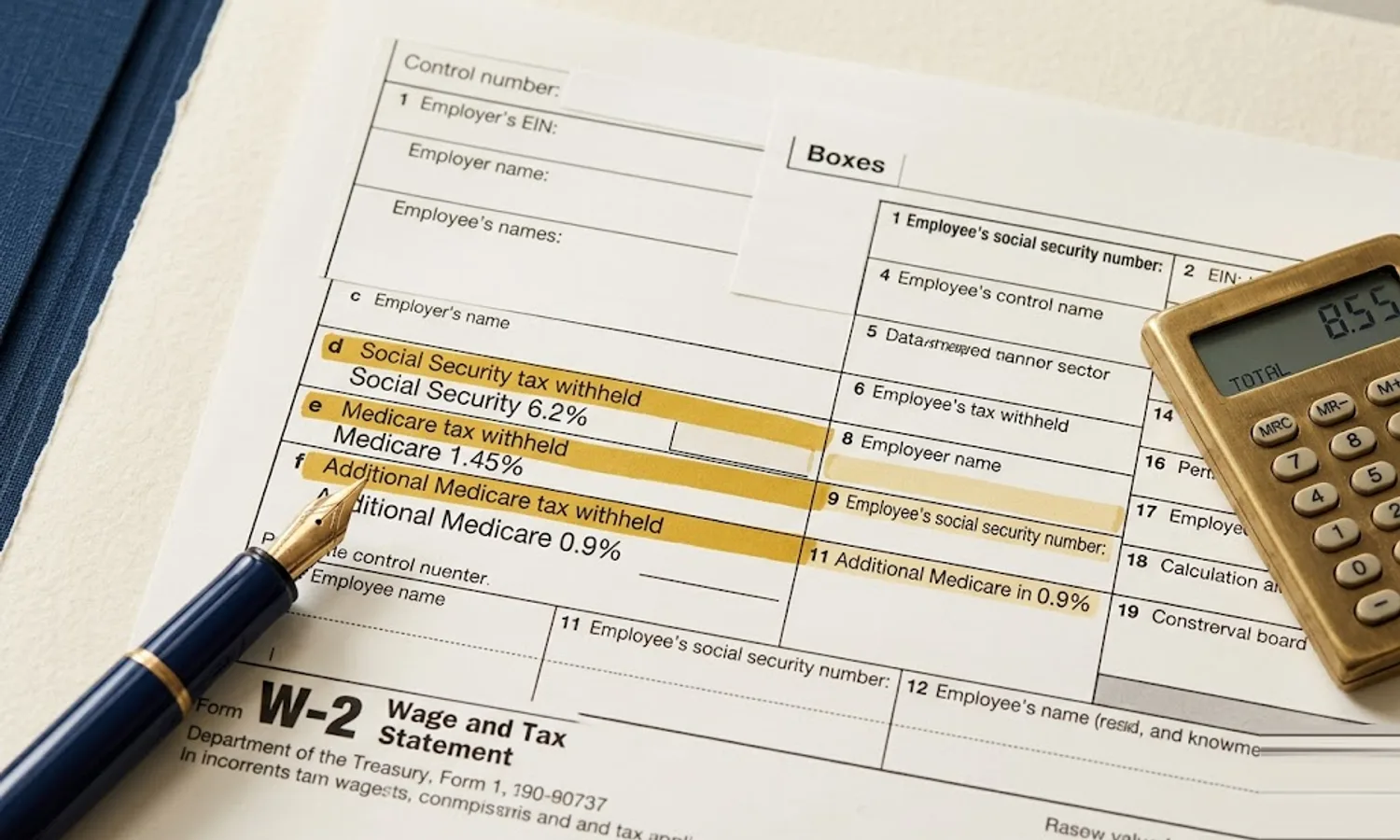
FICA is the single largest line of payroll tax in the United States. For a typical W-2 employee, FICA — the combined 6.2% Social Security and 1.45% Medicare withholding — exceeds federal income tax withholding for the first several wage brackets and remains substantial throughout the income distribution. For a self-employed worker filing Schedule SE, the equivalent SECA tax at 15.3% (both halves combined) often exceeds federal income tax for the first $50,000-$80,000 of net profit. Yet FICA is one of the most consistently misunderstood pieces of the US tax system, partly because it lives in the payroll withholding mechanics rather than on Form 1040, and partly because its design changed materially with the Affordable Care Act in 2010 in ways that affect higher earners differently each year.
The short answer: the employee side of FICA is 7.65% — 6.2% for Social Security plus 1.45% for Medicare. The employer pays the same 7.65% on the same wages, so the combined rate is 15.3%. The 6.2% applies only up to the annual Social Security wage base, $184,500 for 2026, which caps the employee Social Security tax at $11,439.00 for the year; the 1.45% Medicare portion has no ceiling at all. The practical consequence is that once wages cross the base, the marginal FICA rate drops from 7.65% to 1.45% — and for high earners an extra 0.9% Additional Medicare Tax applies above the statutory thresholds, with no employer match.
This guide walks through how FICA payroll taxes are computed, what each component funds, why the wage base for the Social Security portion matters for high earners, how the 0.9% Additional Medicare Tax interacts with the standard FICA structure, how the self-employed (SECA) treatment mirrors the employer/employee split, and what the structural ceiling on FICA looks like in 2026 for typical workers. The 2026 wage base is confirmed — the Social Security Administration published it in the Federal Register on November 3, 2025 — and every rate cited here is checked against the statute or the agency notice that sets it.
What FICA actually is
The Federal Insurance Contributions Act of 1935 created the modern payroll tax structure that funds the United States’ two largest social insurance programs. Two separate taxes are collected under the FICA umbrella, with two separate funding purposes:
Social Security tax (often called OASDI on pay stubs, for Old-Age, Survivors, and Disability Insurance). Funds the Social Security retirement, survivor, and disability programs administered by the Social Security Administration. Rate: 6.2% of wages on the employee side, matched 6.2% by the employer, for a combined 12.4%. Applied only to wages up to an annual wage base ($176,100 in 2025, a confirmed $184,500 in 2026, and a projected $190,200 in 2027; it rises each year with average wage growth).
Medicare tax (often labeled “Medicare” or “MED” on pay stubs). Funds Medicare Part A, the hospital insurance program administered by the Centers for Medicare & Medicaid Services. Rate: 1.45% of wages on the employee side, matched 1.45% by the employer, for a combined 2.9%. Applied to ALL wages with NO wage base — every dollar of wages is subject to the Medicare tax.
Additional Medicare Tax (the 0.9% Affordable Care Act surtax). Added by the ACA in 2010, applies on top of the standard 1.45% Medicare tax for higher earners. Applies only to the employee portion (no employer match). Applied to wages above filing-status thresholds ($200,000 single, $250,000 joint, $125,000 MFS). The thresholds are NOT indexed for inflation.
The combined effective FICA rate for a typical W-2 employee under the Social Security wage base: 7.65% on the employee side (6.2% Social Security + 1.45% Medicare), matched by 7.65% on the employer side, for a total economic tax burden of 15.3% of wages.
Above the Social Security wage base for the year, the employee rate drops to 1.45% (Medicare only) and the employer rate drops to 1.45%, for a combined burden of 2.9%. The wage base creates a meaningful “FICA cliff” each year for high earners — the marginal payroll tax burden cuts roughly in half the moment year-to-date wages cross the wage base figure.
The Additional Medicare Tax adds 0.9% on the employee side above $200,000 of wages (regardless of filing status; the employer withholds based on the $200K trigger for any employee), with year-end reconciliation on Form 8959 against the filing-status-specific threshold.
The Social Security wage base — the annual ceiling on the 6.2% portion
The Social Security Administration sets the annual wage base each October for the following calendar year. The base is the maximum amount of wages subject to the 6.2% Social Security tax in that calendar year. Recent and current figures:
| Tax year | Wage base | YoY increase | Maximum SS tax per worker |
|---|---|---|---|
| 2021 | $142,800 | — | $8,853.60 |
| 2022 | $147,000 | +2.9% | $9,114.00 |
| 2023 | $160,200 | +9.0% | $9,932.40 |
| 2024 | $168,600 | +5.2% | $10,453.20 |
| 2025 | $176,100 | +4.4% | $10,918.20 |
| 2026 | $184,500 | +4.8% | $11,439.00 |
The “maximum SS tax per worker” column is the maximum Social Security tax (employee side, 6.2%) any W-2 employee will pay in that year regardless of how much they earn above the base. For self-employed filers, the maximum SECA Social Security portion is double the figure ($21,836.40 in 2025) because they pay both halves.
The wage base is not the only annual adjustment to Social Security. Three other figures move with the same SSA cost-of-living adjustment process:
Maximum monthly Social Security benefit at full retirement age: $3,822/month in 2024, $4,018/month in 2025, $4,152/month in 2026.
Annual earnings test cap for retirees still working (different from the wage base): $24,480 in 2026 below full retirement age; $65,160 in 2026 in the year full retirement age is reached. How the withholding actually works — and why it is a deferral, not a penalty — is covered in the Social Security earnings test guide.
Substantial Gainful Activity threshold for SSDI disability eligibility: $1,690/month in 2026 ($2,830/month for blind individuals).
For wage-base purposes specifically — the figure that matters for FICA calculation — the 2025 number is $176,100 and the 2026 number is $184,500 (announced by the SSA in October 2025), a 4.8% increase that lifts the maximum employee Social Security tax to $11,439.00. The 2027 round of all these adjustments is being determined right now: the July–September 2026 CPI-W readings fix the COLA that the SSA will announce in mid-October, and our COLA 2027 tracker follows each month’s input as it publishes.
The Medicare 1.45% — uncapped, the structural floor on FICA
The Medicare 1.45% tax has no wage base, which means every dollar of wages is subject to it regardless of how high the worker’s annual earnings go. A worker earning $500,000 of wages pays 1.45% × $500,000 = $7,250 of standard Medicare tax (employee side), matched by another $7,250 from the employer.
The structural fact: Medicare tax keeps accumulating long after Social Security tax stops. For a worker at $400,000 of wages in 2025:
- Social Security tax: 6.2% × $176,100 (capped at wage base) = $10,918.20
- Medicare tax (standard): 1.45% × $400,000 = $5,800
- Additional Medicare tax: 0.9% × ($400,000 - $200,000) = $1,800
- Total employee FICA + Additional Medicare: $18,518.20
- Employer match (Social Security + standard Medicare only): $10,918.20 + $5,800 = $16,718.20
- Total economic FICA burden on the worker’s $400,000 of wages: $35,236.40 (8.8%)
The 0.9% Additional Medicare Tax adds disproportionately to high earners’ FICA burden because the wage base ceiling does not apply to it — the surtax is on top of the uncapped 1.45% Medicare base, applied to every dollar above the $200K trigger threshold. For a single filer at $1 million of wages, the Additional Medicare Tax alone is 0.9% × $800,000 = $7,200 — roughly two-thirds of the $11,439 maximum Social Security tax for 2026, and unlike that tax it keeps growing with every additional dollar of wages.
The Additional Medicare Tax — the ACA-era surtax structure
The Additional Medicare Tax was added by the Affordable Care Act in 2010 as part of the financing structure for ACA Medicare expansion. The tax structure:
Trigger thresholds (NOT indexed for inflation since enactment):
- Single, head of household, qualifying surviving spouse: $200,000
- Married filing jointly: $250,000
- Married filing separately: $125,000
Rate: 0.9% on wages, self-employment income, and railroad retirement compensation above the filing-status threshold.
Employer withholding rule: The employer is required to withhold the 0.9% on any single employee’s wages above $200,000, regardless of the employee’s filing status. The withholding rule is the same flat $200,000 trigger for everyone because the employer cannot know the employee’s filing status reliably.
Year-end reconciliation: At tax time, the worker files Form 8959 with Form 1040. The form computes the actual Additional Medicare Tax owed based on filing status and combined household wages (for joint filers, where both spouses’ wages combine against the $250,000 threshold). If the employer over-withheld (a married joint filer whose wages individually exceeded $200,000 but whose combined household wages did not exceed $250,000), the excess withholding is refunded as part of the regular Form 1040 refund. If the employer under-withheld (two-earner households where neither spouse individually exceeded $200,000 but combined wages did exceed $250,000), the worker owes the difference on Form 1040.
The non-indexation is the structurally important feature. The thresholds have been the same nominal dollar amounts ($200K / $250K / $125K) since 2013, while nominal wages have grown approximately 30-40% over the same period. A household earning $230,000 in 2013 was clearly below the joint threshold; the same household earning $300,000 a decade later (consistent with average wage growth) is well above it. Each year, more US households move into Additional Medicare Tax exposure, a phenomenon sometimes called “bracket creep” but specific to the ACA surtax.
The Net Investment Income Tax — see the NIIT glossary entry — uses the same $200K/$250K modified adjusted gross income thresholds with the same non-indexation design. The two surtaxes were enacted together and operate as a pair: one on wages/SE income (Additional Medicare), one on investment income (NIIT). For households above the thresholds, both apply.
Self-employment FICA equivalent — Schedule SE and the SECA structure
Self-employed workers do not have an employer to match the FICA payroll tax. Instead, they pay both halves themselves via the Self-Employment Contributions Act (SECA) tax computed on Schedule SE. The rates mirror FICA:
- Social Security portion: 12.4% (both halves) on net self-employment income up to the wage base
- Medicare portion: 2.9% (both halves) on all net self-employment income
- Additional Medicare Tax: 0.9% on net SE income above filing-status thresholds
For a self-employed filer with $100,000 of Schedule C net profit in 2025:
- Social Security portion: 12.4% × $92,350 (net of the 7.65% adjustment from Schedule SE Section A line 4a) = $11,451
- Medicare portion: 2.9% × $92,350 = $2,678
- Total SE tax: $14,129
- Half of SE tax deduction (Schedule 1 line 15, above-the-line): $7,065
The “half of SE tax” deduction on Schedule 1 line 15 mirrors the employer-share treatment for W-2 workers — recognizing that the self-employed filer is effectively paying both the employee and employer halves. Deducting half above the line reduces adjusted gross income on Form 1040 and approximates the W-2 treatment in which the employer half is not part of taxable wages.
The full Schedule SE mechanics guide walks through the computation in more detail, including the wage base interaction with employed-plus-self-employed filers (workers who have both W-2 income and SE income aggregate against a single wage base, which can substantially reduce the SECA Social Security portion).
What FICA actually funds — and the trust fund mechanics
The FICA collections from each paycheck do not directly fund the specific benefits that the worker will receive in retirement. The Social Security tax flows into the Old-Age and Survivors Insurance (OASI) and Disability Insurance (DI) trust funds, which pay current benefits to current retirees and disability recipients. The Medicare tax flows into the Hospital Insurance (HI) trust fund, which pays Medicare Part A benefits to current beneficiaries.
The pay-as-you-go structure means current workers’ FICA taxes fund current beneficiaries’ benefits, with any surplus (when payroll collections exceed benefit payments) held in special-issue Treasury securities in the trust funds. Annual Social Security Administration and CMS Trustees Reports detail the trust fund balances and project when scheduled benefits will exceed projected collections.
The implication for personal-finance planning: FICA tax is best understood as a current consumption tax with a future benefit promise, not as a contribution to a personal account. The benefit calculation uses the worker’s earnings history (the 35 highest-earning years adjusted for wage growth) rather than the worker’s total tax payments. The Social Security Administration’s “Quick Calculator” (ssa.gov/OACT/quickcalc/) estimates a worker’s benefit based on the earnings history on file.
Pay stub line-by-line — what each FICA line means
A typical 2025 W-2 pay stub for a worker earning $80,000 annually:
| Line | Amount per pay period (biweekly) | Annual | Calculation |
|---|---|---|---|
| Gross wages | $3,076.92 | $80,000 | $80,000 / 26 |
| OASDI / Social Security | $190.77 | $4,960 | 6.2% × $80,000 |
| Medicare | $44.62 | $1,160 | 1.45% × $80,000 |
| Federal income tax withholding | varies by W-4 | varies | per IRS Pub 15-T |
| State income tax | varies by state | varies | per state |
| 401(k) pretax | varies by election | varies | per worker election |
| Net pay | residual | residual | gross minus all above |
A worker at $300,000 of wages in 2025 has additional lines:
| Line | Annual | Calculation |
|---|---|---|
| OASDI / Social Security | $10,918.20 | 6.2% × $176,100 (capped at wage base) |
| Medicare (standard) | $4,350 | 1.45% × $300,000 |
| Additional Medicare withholding | $900 | 0.9% × ($300,000 - $200,000) |
| Total FICA + Additional Medicare | $16,168.20 | sum |
The worker would file Form 8959 at year end to reconcile the Additional Medicare withholding against the actual filing-status threshold. For a single filer at $300,000, the withholding matches the actual liability; for a joint filer at $300,000 whose spouse earned $0, the actual liability is 0.9% × ($300,000 - $250,000) = $450, and the $450 of over-withholding is refunded with the rest of the return.
How FICA interacts with pre-tax and Roth retirement contributions
One of the structural features of FICA that catches many savers off-guard is that pre-tax 401(k) contributions reduce federal income tax but do NOT reduce FICA tax. HSA contributions through payroll deduction are the exception — they avoid FICA entirely, which is why the HSA is the only account with a true triple tax advantage. The FICA wage base is computed on gross wages before income tax adjustments, but specifically inclusive of pre-tax retirement contributions for FICA purposes.
A worker earning $100,000 of gross W-2 wages who contributes $24,500 to a pre-tax 401(k) in 2026:
- W-2 box 1 (federal income tax wages): $75,500 ($100,000 minus $24,500 pre-tax 401(k))
- W-2 box 3 (Social Security wages): $100,000 (FICA does not exclude pre-tax 401(k))
- W-2 box 5 (Medicare wages): $100,000 (FICA does not exclude pre-tax 401(k))
- Federal income tax withholding: based on $75,500
- FICA withholding: 6.2% + 1.45% = 7.65% × $100,000 = $7,650
The exception is pre-tax health insurance premiums and HSA contributions made via the Section 125 cafeteria plan — these DO reduce FICA wages. A worker contributing $4,400 to an HSA via payroll under a cafeteria plan saves 7.65% × $4,400 = $337 of FICA tax in addition to the federal income tax savings. The same HSA contribution made outside of payroll (the worker writing a check from a personal bank account) is deductible on Schedule 1 line 13 for income tax purposes but does NOT reduce FICA — the worker pays FICA on the full gross wages and only gets the income tax deduction.
The implication: maximizing HSA contributions through payroll specifically (not through outside contributions) captures both the income tax and the FICA tax benefit. The structural difference of 7.65% on $4,400 ($337 in 2026) is the FICA savings that disappears if the contribution is made outside payroll. Over a working career, the cumulative FICA savings from payroll-routed HSA contributions can exceed $10,000.
Roth 401(k) and Roth IRA contributions follow the same FICA rule as pre-tax 401(k) — they do not reduce FICA wages, regardless of whether the contribution is pre-tax or Roth. The federal income tax treatment differs (pre-tax reduces current-year income tax; Roth does not), but the FICA treatment is identical.
Annual FICA planning patterns
Three structural FICA patterns that high earners should understand:
1. The wage base cliff and mid-year transition. For workers who will earn above the Social Security wage base in a given year ($184,500 in 2026), the marginal FICA rate cuts from 7.65% to 1.45% the moment YTD wages cross the base. A worker reaching the base in early September has 4 months of paychecks at the lower 1.45% rate. The cliff matters most for executive compensation timing — a year-end bonus paid in December (after the wage base is hit) faces lower FICA than the same bonus paid in March (before the base is hit). For most workers this is not actionable (employer payroll schedules are fixed), but for self-employed filers and executives with bonus timing flexibility, the cliff is real.
2. Two-earner household coordination. Each individual worker has their own Social Security wage base. A household with two workers earning $130,000 each ($260,000 combined) pays 6.2% × $260,000 = $16,120 in Social Security tax — both workers are under the $184,500 base individually and contribute the full 6.2%. The same household with one worker earning $260,000 and one earning $0 pays only 6.2% × $184,500 = $11,439 — the higher earner is capped at the base. The “marriage Social Security advantage” of roughly $4,700 of avoided tax is one of the few structural features that favors married single-earner households over married dual-earner households in the US tax system.
3. The Additional Medicare withholding refund/owed timing. The employer withholds the 0.9% Additional Medicare on wages above $200K based on the individual employee’s wages — but the actual liability is computed against the filing-status threshold of the household ($250K joint, $200K single, $125K MFS). Married joint filers with one spouse earning $230K and the other earning $10K had $270 of Additional Medicare withheld during the year ($30K × 0.9%) but actually owe $0, because their combined wages of $240K are below the $250K joint threshold. The $270 over-withholding refunds with the regular Form 1040 refund. Reverse case: two-earner married joint where both earn $180K each — neither individually exceeds the $200K withholding trigger, so $0 was withheld during the year, but combined wages of $360K produce $990 of Additional Medicare tax owed ($110K × 0.9%) at filing. The household needs to plan for the year-end true-up if their withholding does not match their actual filing-status liability.
These three patterns surface in nearly every high-income household’s tax planning, and missing any one of them can produce surprise tax bills at filing time or sub-optimal compensation timing decisions.
What this guide does not cover
This guide focused on US FICA payroll taxes for W-2 employees and the SECA equivalent for self-employed workers. It does not cover:
- Detailed Social Security benefit calculation — the 35-year earnings history rule, the AIME (Average Indexed Monthly Earnings) computation, the PIA (Primary Insurance Amount) bend points, the early-retirement reduction and delayed-retirement credit factors. Each is its own substantial topic.
- Specific Medicare program coverage — Part A (hospital, funded by FICA Medicare), Part B (outpatient, funded by general revenues and premiums), Part C (Medicare Advantage), Part D (prescription drugs). The premium structures and IRMAA brackets (income-related monthly adjustment amounts) for higher-income retirees are separate topics.
- Railroad Retirement Tier I and Tier II — railroad workers are covered by a separate pension system rather than Social Security, with payroll taxes structured differently. The Tier I portion is roughly equivalent to FICA; Tier II is additional.
- State-level disability insurance taxes (California SDI, New Jersey TDI, New York PFL, Hawaii TDI, Rhode Island TDI, Puerto Rico SINOT) — separate state-level payroll taxes that fund state disability programs and are unrelated to FICA.
- Federal Unemployment Tax Act (FUTA) and state unemployment insurance — payroll taxes paid entirely by the employer (not split with the worker), funding unemployment benefits. Not part of FICA but appears as related payroll taxes for employer accounting purposes.
Each of those is a substantial topic in its own right.
Sources
- Social Security Administration, the canonical source for the annual wage base, benefit amounts, and substantial-gainful-activity thresholds: SSA — Contribution and Benefit Base.
- Internal Revenue Service, the form and instructions for the Additional Medicare Tax reconciliation: About Form 8959 — Additional Medicare Tax.
- Internal Revenue Service, the publication covering employer payroll tax obligations including FICA withholding and matching: Publication 15 (Circular E) — Employer’s Tax Guide.
- Internal Revenue Service, the schedule and instructions for self-employment tax computation: About Schedule SE (Form 1040).
- Social Security Administration, the annual Trustees Report documenting trust fund balances and long-range financial projections: SSA — Trustees Report.
- Centers for Medicare and Medicaid Services, the Medicare Trustees Report for the Hospital Insurance trust fund: CMS — Medicare Trustees Report.
- Social Security Administration, 2026 COLA fact sheet (wage base, maximum benefit at full retirement age, substantial gainful activity): ssa.gov/news/press/factsheets/colafacts2026.pdf.
- IRS Notice 2025-67 (2026 elective deferral limit $24,500): irs.gov/pub/irs-drop/n-25-67.pdf.
Quick answers
What is FICA on my pay stub and how is it calculated?
FICA stands for the Federal Insurance Contributions Act, the 1935 statute that created the Social Security payroll tax. On a modern W-2 pay stub, "FICA" is typically broken into two lines: Social Security tax (6.2% of wages up to an annual wage base, $168,600 in 2024 / $176,100 in 2025, increasing with each year's inflation adjustment) and Medicare tax (1.45% of all wages with no cap). The employer matches both — paying another 6.2% Social Security and 1.45% Medicare on the same wages — so the total FICA tax on wages is 15.3% of pay up to the Social Security wage base, dropping to 2.9% on wages above the base (Medicare only). Self-employed filers pay both halves themselves via Schedule SE, called Self-Employment Contributions Act (SECA) tax, also computed at 15.3% up to the base and 2.9% above.
What is the Additional Medicare Tax and when does it apply?
The Additional Medicare Tax is a 0.9% surtax on wages, self-employment income, and railroad retirement compensation above filing-status thresholds: $200,000 for single and head of household, $250,000 for married filing jointly, $125,000 for married filing separately. The surtax applies only to the employee portion (not the employer match) and only to the wages above the threshold (not all wages). It was enacted as part of the Affordable Care Act in 2010 to fund Medicare Part A expansion. The thresholds are NOT indexed for inflation — same nominal dollar amounts every year since enactment — which means an increasing share of US workers becomes subject to the surtax each year as wages rise. Employer withholding is mandatory at 0.9% on wages above $200,000 regardless of the worker's filing status, with reconciliation happening at year-end on Form 8959.
Is the Social Security wage base going up in 2026?
Yes — the Social Security Administration adjusts the wage base each October for the following calendar year based on national wage growth. The 2024 wage base was $168,600; the 2025 wage base is $176,100. The 2026 wage base is $184,500, a 4.8% increase over 2025, which raises the maximum employee Social Security tax to $11,439.00. The Medicare 1.45% portion has no wage base — every dollar of wages is subject to Medicare tax — so the only line that moves with the SSA adjustment is the 6.2% Social Security portion. The wage base matters for high earners because the marginal FICA rate drops from 7.65% (6.2% + 1.45%) to 1.45% the moment wages cross the base for that year.
Do FICA taxes count as deductions or do they appear on Form 1040?
FICA taxes do NOT appear as a deduction on Form 1040 for W-2 employees — they are withheld at the paycheck level and never enter the federal income tax computation. The W-2 box 1 wages figure that flows to Form 1040 line 1a is already post-FICA, post-pretax-401(k), post-pretax-HSA, post-pretax-health-insurance. For self-employed filers paying SECA tax via Schedule SE, half of the SE tax is deductible above the line on Schedule 1 line 15, which reduces AGI on Form 1040 line 11. This is the "half of SE tax" deduction that mirrors the employer-share treatment for W-2 workers. The other half of SE tax (the employee-share equivalent) is non-deductible, reflecting the design symmetry between SECA and FICA.
Educational content only. finbarrow is an independent editorial publication, not a licensed financial advisor, broker, tax preparer, or attorney. Verify rates and terms with the issuer or relevant regulator. See disclaimers and funding disclosures.