HDHP vs PPO — the premium-deductible math with HSA
How to compare an HDHP to a PPO: premium savings, deductible risk, out-of-pocket caps, and the HSA tax advantage.
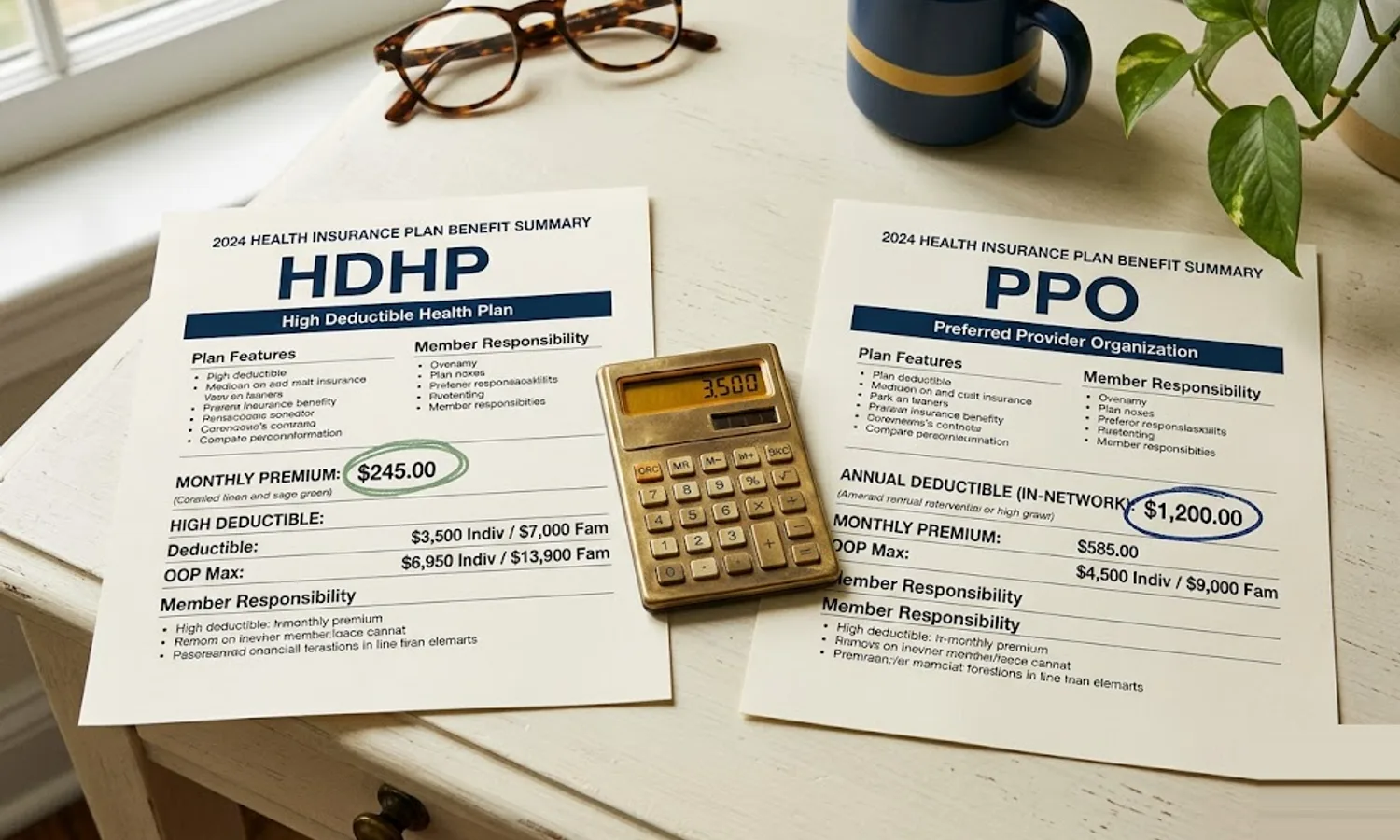
Every autumn, millions of US workers face the same open enrollment question: should they choose the high-deductible health plan or the traditional PPO? The question is framed as a trade-off — lower premiums with the HDHP versus lower out-of-pocket costs with the PPO — and most enrollees resolve it with intuition rather than arithmetic. Healthy workers assume the HDHP is cheaper; workers with chronic conditions or planned procedures assume the PPO is safer. Both assumptions are directionally correct, but neither captures the full picture, because the HDHP carries a structural financial advantage that has no parallel in the PPO: eligibility for a health savings account, the only account in the US tax code that is deductible going in, tax-free while invested, and tax-free coming out for qualified expenses.
This guide walks through the comparison as a math problem: how to compute the break-even point between an HDHP and a PPO at your employer, how the HSA tax advantage shifts that break-even, what the IRS thresholds are for HDHP qualification, how to handle the high-utilization year where the deductible bites, and the long-term wealth effect of a decade of HSA contributions versus a decade of PPO premiums. The HSA as a retirement account guide covers the HSA investment strategy in depth; this guide focuses on the upstream decision of whether to elect the HDHP in the first place.
HDHP vs PPO, in short: the high-deductible plan charges a lower monthly premium but makes you pay the full negotiated price for care until you reach the deductible; the PPO charges more every month but covers routine visits with small copays from day one. The HDHP wins in a low-spending year and the PPO wins in a high-spending year, with the break-even for most employer plans falling between $3,000 and $6,000 of annual healthcare use. The tiebreaker is the health savings account: only an HDHP lets you fund an HSA, which for 2026 accepts up to $4,400 for self-only coverage and $8,750 for a family — the one account that is tax-deductible going in, tax-free while invested, and tax-free coming out for medical costs. To qualify as an HDHP in 2026, a plan needs at least a $1,700 self-only deductible ($3,400 family) and an out-of-pocket maximum no higher than $8,500 self-only ($17,000 family), per IRS Revenue Procedure 2025-19.
The premium savings — where the HDHP starts ahead
The structural design of a high-deductible health plan is straightforward: the insurer charges a lower premium because the enrollee absorbs more of the initial cost through a higher deductible. For employer-sponsored plans in 2025, the average total annual premium for a PPO was $9,818 for single coverage and $28,272 for family coverage, against $8,620 and $25,379 for a high-deductible plan with a savings option — a gap of roughly $1,200 a year for single coverage and roughly $2,900 for family coverage, according to the Kaiser Family Foundation’s 2025 Employer Health Benefits Survey. Across all plan types, workers paid an average of $1,440 of the single premium and $6,850 of the family premium (16% and 26% of the total). How much of the PPO-versus-HDHP premium gap reaches your paycheck depends on how your employer splits the subsidy between the two plans, which is why the next paragraph tells you to look up your own numbers.
These are averages across all US employers. The actual premium difference at any specific employer varies substantially — some employers subsidize the HDHP more heavily to encourage HSA adoption, producing a premium gap of $2,000-$4,000/year for family coverage. Others price the HDHP and PPO similarly, reducing the gap to a few hundred dollars. The first step in the HDHP vs PPO analysis is always to log into your employer’s benefits portal during open enrollment and record the exact premium difference for your coverage tier (self-only, employee-plus-spouse, employee-plus-children, or family).
Many employers also contribute to the HSA on behalf of HDHP enrollees — a “seed” contribution of $500-$1,500/year that is deposited directly into the HSA at the start of the plan year or spread across paychecks. This employer HSA contribution is not taxable income, does not count against the employee’s HSA contribution limit, and effectively increases the premium advantage of the HDHP by the seed amount. If your employer offers an HSA seed, add it to the premium savings column before comparing.
The deductible risk — where the PPO has the advantage
The PPO’s advantage is first-dollar coverage for many services. A typical PPO charges a $30 copay for a primary care visit and a $50 copay for a specialist, with no deductible required before these copays apply. Prescriptions follow a tiered formulary: $10 for generics, $40 for preferred brands, $80 for non-preferred. The enrollee sees predictable, moderate costs for routine care throughout the year.
The HDHP, by contrast, requires the enrollee to pay the full negotiated rate for most services until the deductible is met. A primary care visit that costs $30 as a PPO copay might cost $180-$250 at the HDHP’s negotiated rate. A brand-name prescription that is $40 on the PPO formulary might cost $200-$400 at the HDHP’s negotiated rate. The cost difference is not that the HDHP pays higher prices — both plans negotiate similar rates with providers — but that the PPO subsidizes early costs through higher premiums, while the HDHP passes them through to the enrollee until the deductible is exhausted.
The one exception mandated by federal law: preventive care. Under the Affordable Care Act, all plans — including HDHPs — must cover certain preventive services at no cost to the enrollee before the deductible. Annual physicals, immunizations, screenings (mammograms, colonoscopies, blood pressure and cholesterol tests), and well-child visits are covered at $0 under both plan types. The HDHP’s higher out-of-pocket cost applies to diagnostic and treatment services, not to preventive care.
Computing the break-even — the spending level that decides
The break-even analysis asks: at what annual healthcare spending level does the HDHP’s total cost (premiums plus out-of-pocket) equal the PPO’s total cost? Below the break-even, the HDHP wins; above it, the PPO wins.
The calculation requires four inputs from each plan’s Summary of Benefits and Coverage:
- Annual employee premium (the amount deducted from paychecks, not the total plan cost)
- Deductible (the amount the enrollee pays before the plan begins covering costs)
- Coinsurance rate (the plan’s share of costs after the deductible — typically 80/20 or 90/10)
- Out-of-pocket maximum (the ceiling on annual enrollee spending, after which the plan covers 100%)
A worked example for a family of four with two employer plans:
| HDHP | PPO | |
|---|---|---|
| Annual premium (employee share) | $4,800 | $7,200 |
| Deductible | $3,400 | $500 |
| Coinsurance (plan pays) | 80% | 90% |
| Out-of-pocket max | $7,000 | $5,000 |
At $0 spending (no healthcare used): HDHP costs $4,800 in premiums; PPO costs $7,200. HDHP saves $2,400.
At $3,000 spending (moderate — a few visits, labs, prescriptions): HDHP costs $4,800 + $3,000 = $7,800; PPO costs $7,200 + $500 deductible + ($2,500 × 10% coinsurance) = $7,950. HDHP still slightly cheaper.
At $6,000 spending (one significant event — minor surgery, ER visit): HDHP costs $4,800 + $3,400 deductible + ($2,600 × 20%) = $8,720; PPO costs $7,200 + $500 + ($5,000 × 10%) = $8,200. PPO is now cheaper by $520.
At $15,000+ spending (major event — surgery, childbirth, hospitalization): both plans hit their out-of-pocket maximums. HDHP costs $4,800 + $7,000 = $11,800; PPO costs $7,200 + $5,000 = $12,200. HDHP is cheaper again because the premium savings exceed the out-of-pocket max difference.
This U-shaped pattern — HDHP wins at low spending, PPO wins at moderate-to-high spending, HDHP wins again at catastrophic spending — is typical of most employer plan pairs. The PPO advantage exists only in a band of spending levels, and the width of that band depends on the specific plan designs.
The HSA tax advantage — what changes the math
The comparison above treats healthcare spending as after-tax dollars. But HDHP enrollees can fund their out-of-pocket costs through an HSA, which converts those dollars to pre-tax. The tax savings from the HSA shift the HDHP’s effective cost downward and push the break-even higher.
The 2026 HSA contribution limits are $4,400 for self-only coverage and $8,750 for family coverage (with an additional $1,000 catch-up for enrollees age 55+). Contributions made through employer payroll deduction avoid federal income tax, state income tax (in most states — California and New Jersey do not recognize the HSA deduction), and FICA taxes (Social Security and Medicare). Contributions made outside payroll are deductible on Schedule 1 line 13 but do not avoid FICA.
For a family in the 24% federal marginal bracket, 6% state bracket, and 7.65% FICA rate, the payroll-deduction tax savings on a full $8,750 family HSA contribution is:
$8,750 × (24% + 6% + 7.65%) = $8,750 × 37.65% = $3,294/year in tax savings
This $3,294 is real money that the PPO enrollee does not receive. Added to the premium savings, the HDHP’s total advantage in the worked example above becomes $2,400 + $3,294 = $5,694 in a zero-spending year. The break-even spending level — where the PPO’s lower out-of-pocket cost erases this combined advantage — shifts dramatically upward, often into the catastrophic range where the HDHP’s out-of-pocket max caps total exposure anyway.
The HSA also carries a long-term investment advantage that the annual comparison does not capture. Dollars contributed to an HSA and invested in low-cost index funds grow tax-free. Medical expenses can be paid out of pocket today and reimbursed from the HSA decades later, with no deadline on reimbursement — the HSA receipts strategy allows the full balance to compound for decades before withdrawal. After age 65, HSA withdrawals for any purpose (not just medical) are taxed as ordinary income with no penalty, making the HSA functionally identical to a traditional IRA but with the added benefit of tax-free medical withdrawals. For a household that contributes the family maximum for 20 years at a 7% real return, the HSA balance reaches approximately $370,000 — a substantial retirement asset that exists only because the HDHP was chosen during open enrollment.
The behavioral dimension — why the HDHP changes healthcare consumption
Beyond the financial math, the HDHP changes how enrollees interact with the healthcare system in ways that affect both spending and health outcomes. Research published in the RAND Health Insurance Experiment and subsequent studies consistently finds that higher cost-sharing reduces healthcare utilization — enrollees with larger deductibles make fewer discretionary visits, fill fewer prescriptions, and seek fewer specialist referrals. Whether this is beneficial or harmful depends on which services are deferred.
For low-value care — unnecessary imaging for uncomplicated back pain, brand-name prescriptions where generics are equivalent, specialist visits for conditions that a primary care physician can manage — the HDHP’s cost transparency encourages more efficient consumption. The enrollee who sees a $250 charge for a visit rather than a $30 copay is more likely to ask whether the visit is necessary, whether telehealth would suffice, or whether a generic alternative exists for the prescribed medication. This price awareness is structurally absent from the PPO, where the copay model obscures the true cost of services.
For high-value care — preventive screenings, early-stage diagnostic workups, chronic disease management — the HDHP’s cost barrier can delay necessary treatment. A diabetic enrollee who skips medication refills because the HDHP’s negotiated rate is $200/month rather than the PPO’s $40 copay is saving money in the short term but accumulating medical risk that may produce larger costs later. The evidence on this point is mixed but concerning: the NBER found that HDHP enrollees with chronic conditions reduced spending on both low-value and high-value services, with some measurable increase in emergency department utilization.
The practical resolution is to fund the HSA deductible amount in advance — either from the employer seed, from personal contributions early in the plan year, or from a prior-year rollover. When the HSA has sufficient balance to cover the deductible, the behavioral barrier to seeking necessary care is reduced: the enrollee knows the money is there, earmarked for healthcare, and spending it does not compete with rent or groceries. The HDHP’s cost transparency benefit remains (the enrollee still sees the true price of each service), but the financial anxiety that causes harmful care avoidance is mitigated.
Families with children — how the calculus shifts
For families with young children, the HDHP vs PPO math includes utilization patterns that single adults and couples rarely encounter. Well-child visits and immunizations are covered as preventive care under both plan types, but sick visits — the ear infections, fevers, strep tests, and urgent care trips that are routine in households with children under age six — fall under the deductible in an HDHP. A family with two young children might average eight to twelve sick visits per year at $150-$250 per visit, generating $1,200-$3,000 in pre-deductible charges that the PPO would have covered with $30 copays ($240-$360 total).
The family deductible structure matters here. Most HDHPs use an embedded deductible design for family coverage: each family member has an individual deductible (typically half the family deductible), and once any single member reaches the individual deductible, the plan begins paying for that member’s care even if the family deductible has not been met. Under an aggregate (non-embedded) design, no family member receives plan coverage until the entire family deductible is met, which can delay coverage in families where one member generates most of the claims. The Summary of Benefits and Coverage specifies which design your plan uses — check before enrolling.
Despite the higher per-visit cost, the HDHP often wins for families because the premium difference on family-tier coverage is largest in absolute terms ($1,400-$4,000/year), and the HSA contribution limit for family coverage ($8,750 in 2026) produces the largest tax savings. A family in the 24% federal bracket with a 6% state tax rate and FICA avoidance saves over $3,200/year on a maximum HSA contribution — more than enough to fund the typical sick-visit spending for a household with young children.
When the PPO is the right choice
The HDHP-with-HSA combination is structurally superior for most households, but not all. The PPO is the better choice when:
Cash reserves are insufficient to cover the deductible. An HDHP enrollee who cannot absorb a $3,400 family deductible without credit card debt is paying effective interest rates that erode the premium and tax savings. The HSA advantage assumes the enrollee can fund the deductible from savings or the HSA balance — if the HSA is empty (first year of enrollment) and the emergency fund is thin, the HDHP’s deductible exposure is a genuine financial risk. The emergency fund guide covers the target balance that should be in place before electing an HDHP.
A planned high-cost medical event is certain. If a household knows with certainty that a surgery, childbirth, or extended treatment will occur in the plan year, the PPO’s lower deductible and richer coinsurance produce lower total cost in the moderate-to-high spending band. The HSA tax savings partially offset this, but for a single year with predictable high utilization, the PPO often wins net of HSA. The exception is catastrophic spending that hits the out-of-pocket maximum under both plans — in that scenario, the HDHP is cheaper because premiums are lower and the max is a fixed ceiling.
The employer does not contribute to the HSA. If the premium difference between the HDHP and PPO is small and there is no employer HSA seed, the HDHP’s advantage shrinks to the enrollee’s own tax savings on voluntary contributions. For a household in a low marginal bracket (12-15%) with moderate healthcare needs, the PPO may be cheaper in total cost for most utilization scenarios.
The enrollee is in California or New Jersey. These states do not recognize the HSA deduction for state income tax purposes and tax HSA investment gains annually. The federal and FICA tax advantage remains, but the total tax benefit is reduced by 6-10 percentage points compared to states that conform to the federal HSA treatment.
The open enrollment checklist
Open enrollment typically runs for two to four weeks in autumn, and the decision locks for the full following plan year (unless a qualifying life event occurs). The following checklist produces a data-driven decision rather than an intuitive one:
- Record the annual employee premium for each plan option at your coverage tier.
- Record each plan’s deductible, coinsurance rate, and out-of-pocket maximum from the Summary of Benefits and Coverage.
- Estimate your household’s expected healthcare spending for the coming year. Use last year’s Explanation of Benefits statements as a baseline, adjusted for any known changes (planned procedures, new prescriptions, aging into new screening recommendations).
- Compute total cost (premium + estimated out-of-pocket) under each plan at your expected spending level.
- If the HDHP is available and you have sufficient reserves to cover the deductible, add the HSA tax savings at your marginal rate to the HDHP’s advantage column.
- Factor in any employer HSA seed contribution.
- Compare. If the HDHP wins at your expected spending level and you can absorb the deductible, elect the HDHP and contribute at least enough to the HSA to cover the deductible in year one, with maximum contribution as the long-term target.
The math is specific to your employer’s plan designs and your household’s marginal tax rate. The general principle is structural: the HDHP-with-HSA combination wins for the majority of healthy-to-moderate-utilization households because the tax advantage is a guaranteed return, while the PPO’s advantage requires a specific band of healthcare spending that may or may not materialize.
Common mistakes in the HDHP vs PPO comparison
Ignoring the HSA entirely. The most frequent error is comparing only premiums and out-of-pocket costs without including the HSA tax savings. An analysis that concludes “the PPO is cheaper above $4,000 of spending” may reverse to “the HDHP is cheaper at all spending levels” once the HSA tax benefit is included. The HSA is not a bonus feature of the HDHP — it is the central reason the HDHP exists as a plan design.
Treating the HSA as a spending account. Enrollees who contribute to the HSA and immediately spend it on copays and prescriptions capture the tax deduction but forfeit the investment growth. The optimal strategy — documented in the HSA as retirement account guide — is to pay current medical expenses from checking, invest the HSA balance in low-cost index funds, and defer reimbursement until retirement or a future year. The difference between spending the HSA immediately and investing it for 25 years at 7% real return is approximately 5× on every dollar contributed.
Forgetting that the HDHP decision also affects MAGI. HSA contributions through payroll reduce AGI and therefore reduce every MAGI-tested phase-out: Roth IRA eligibility, NIIT threshold, IRMAA tiers, education credit phase-outs. A household near a MAGI cliff that elects the PPO over the HDHP forfeits not only the HSA tax savings but also the downstream MAGI management benefit of the HSA deduction. For high-income households, this secondary effect can be as valuable as the primary tax deduction.
Comparing plan-year costs without considering multi-year effects. The HDHP’s advantage compounds over time because HSA balances roll over indefinitely and grow tax-free. A household that elects the HDHP for ten consecutive years accumulates an HSA balance that has no equivalent under the PPO. A single-year comparison in which the PPO wins by $500 may be overwhelmed by the long-run HSA investment value — $8,750/year at 7% real return for ten years produces approximately $121,000 in HSA assets. The PPO never produces a comparable wealth effect.
Sources
- Kaiser Family Foundation — 2025 Employer Health Benefits Survey, Summary of Findings (average premiums by plan type; average worker contributions). kff.org/health-costs/2025-employer-health-benefits-survey
- IRS Revenue Procedure 2025-19 — 2026 HSA contribution limits and HDHP minimum deductible/maximum out-of-pocket thresholds. irs.gov/pub/irs-drop/rp-25-19.pdf
- IRS Publication 969 — Health Savings Accounts and Other Tax-Favored Health Plans. irs.gov/pub/irs-pdf/p969.pdf
- ACA preventive care mandate — HealthCare.gov coverage of preventive services under all marketplace and employer plans. healthcare.gov/coverage/preventive-care-benefits
Quick answers
Is an HDHP always cheaper than a PPO?
Not always in total cost, but always in premium cost. An HDHP charges lower monthly premiums than a PPO because it shifts more of the first-dollar cost to the enrollee via a higher deductible. Whether the HDHP is cheaper in total depends on how much healthcare the enrollee actually uses. In a low-utilization year — a few office visits, generic prescriptions, no hospitalizations — the HDHP saves the full premium difference and the high deductible is never reached. In a high-utilization year — a surgery, a delivery, an ER visit — the enrollee pays the full deductible before the plan begins covering costs, which can erase or exceed the premium savings. The break-even point for most employer-sponsored plans falls somewhere between $2,000 and $5,000 of annual healthcare spending, depending on the specific plan designs. Below that spending level, the HDHP wins on total cost; above it, the PPO wins — unless the HSA tax savings are factored in, which shifts the break-even upward by $800-$2,000 depending on marginal tax rate.
What makes a plan qualify as an HDHP for HSA purposes?
The IRS defines an HDHP by two numeric tests that are updated annually for inflation: a minimum deductible and a maximum out-of-pocket limit. For 2026, the minimum deductible is $1,700 for self-only coverage ($3,400 for family). The maximum out-of-pocket limit is $8,500 for self-only ($17,000 for family). A plan must meet both thresholds to qualify. The deductible must apply broadly — plans that cover certain services before the deductible (such as preventive care, which the ACA requires all plans to cover at no cost) remain HDHP-eligible, but plans that cover non-preventive office visits or prescriptions with a copay before the deductible may fail the HDHP test. The qualification is checked monthly: if an enrollee switches from an HDHP to a PPO mid-year, HSA contribution eligibility is prorated for the months the HDHP was active.
Can I have an HSA if I choose the PPO?
No. HSA eligibility requires enrollment in a qualifying HDHP as the only health coverage. A PPO, HMO, or any plan that does not meet the IRS minimum deductible and maximum out-of-pocket thresholds disqualifies the enrollee from making new HSA contributions. If the enrollee previously had an HSA and switches to a PPO, the existing HSA funds remain — they can still be invested and withdrawn for qualified medical expenses tax-free — but no new contributions can be made until the enrollee re-enrolls in an HDHP. This is the single most consequential feature of the HDHP vs PPO decision: choosing the PPO means forfeiting the HSA contribution for that year, which for a family in the 32% marginal bracket is worth approximately $2,800 in federal tax savings alone ($8,750 × 0.32), not counting state tax savings or the long-term investment growth of those dollars.
How do I calculate the break-even point between an HDHP and PPO?
The break-even is the annual healthcare spending level at which total cost (premiums plus out-of-pocket) is equal under both plans. Start with the annual premium difference — if the PPO costs $500/month and the HDHP costs $300/month, the HDHP saves $2,400/year in premiums. Then compute total out-of-pocket at increasing spending levels under each plan: the HDHP enrollee pays 100% of costs until the deductible, then the coinsurance rate until the out-of-pocket maximum; the PPO enrollee pays copays for office visits and a lower deductible with coinsurance above it. The spending level at which the PPO's lower out-of-pocket costs exactly offset the HDHP's lower premiums is the break-even. For most employer plans, this falls between $3,000 and $6,000 of billed charges. Below the break-even, choose the HDHP; above it, the PPO costs less in total — unless the HSA tax benefit is included, which lowers the HDHP's effective cost and pushes the break-even higher.
What is the difference between an HDHP and a PPO?
An HDHP (high-deductible health plan) and a PPO (preferred provider organization) describe two different things, which is part of why the comparison confuses people. "PPO" describes a plan's provider network and referral rules — you can see specialists without a referral and use out-of-network providers at a higher cost. "HDHP" describes a plan's cost structure — a high deductible and the legal qualification to pair with a health savings account. A single plan can be both a PPO in network design and an HDHP in cost structure. In everyday open-enrollment language, though, "PPO" usually means the richer, higher-premium plan with low copays and first-dollar coverage, while "HDHP" means the lower-premium plan with a high deductible and an HSA. The practical difference is where you pay: the PPO charges more every month in premiums; the HDHP charges less monthly but more when you actually use care, until the deductible is met.
What is the difference between an HDHP and an HSA?
They are not the same thing, and confusing them is one of the most common open-enrollment mistakes. An HDHP is the health insurance plan; an HSA (health savings account) is a tax-advantaged savings account you can only open and fund if you are enrolled in a qualifying HDHP. The HDHP is the door; the HSA is the room behind it. You choose the HDHP during open enrollment, and that choice unlocks the ability to fund an HSA — the only account that is tax-deductible going in, tax-free while invested, and tax-free coming out for qualified medical expenses. A PPO does not unlock an HSA. So "HDHP vs HSA" is not really a comparison at all; the real comparison is HDHP-with-HSA versus PPO.
Is an HDHP or a PPO better for a family?
For most families it comes down to three things: the premium gap, your cash reserves, and your expected healthcare use. Families often benefit most from the HDHP because the premium difference on family-tier coverage is the largest in absolute dollars (a $1,400 to $4,000 a year gap is common) and the family HSA contribution limit ($8,750 in 2026) produces the largest tax savings — over $3,000 a year for a household in the 24% bracket with state tax and FICA avoidance. The catch for families with young children is the volume of sick visits, which fall under the deductible in an HDHP. A family that can cover its deductible from savings or the HSA generally still comes out ahead, while a family with thin reserves or a planned high-cost event such as a surgery or a delivery may find the PPO's lower deductible cheaper for that single year. Run the break-even at your own plans' numbers before deciding.
Educational content only. finbarrow is an independent editorial publication, not a licensed financial advisor, broker, tax preparer, or attorney. Verify rates and terms with the issuer or relevant regulator. See disclaimers and funding disclosures.