Form 1099-B to Form 8949: covered, noncovered, Box A-F
How covered vs noncovered and the box 12 basis-reported check decide which Form 8949 category box (A through F) your stock sale lands in, box by box.
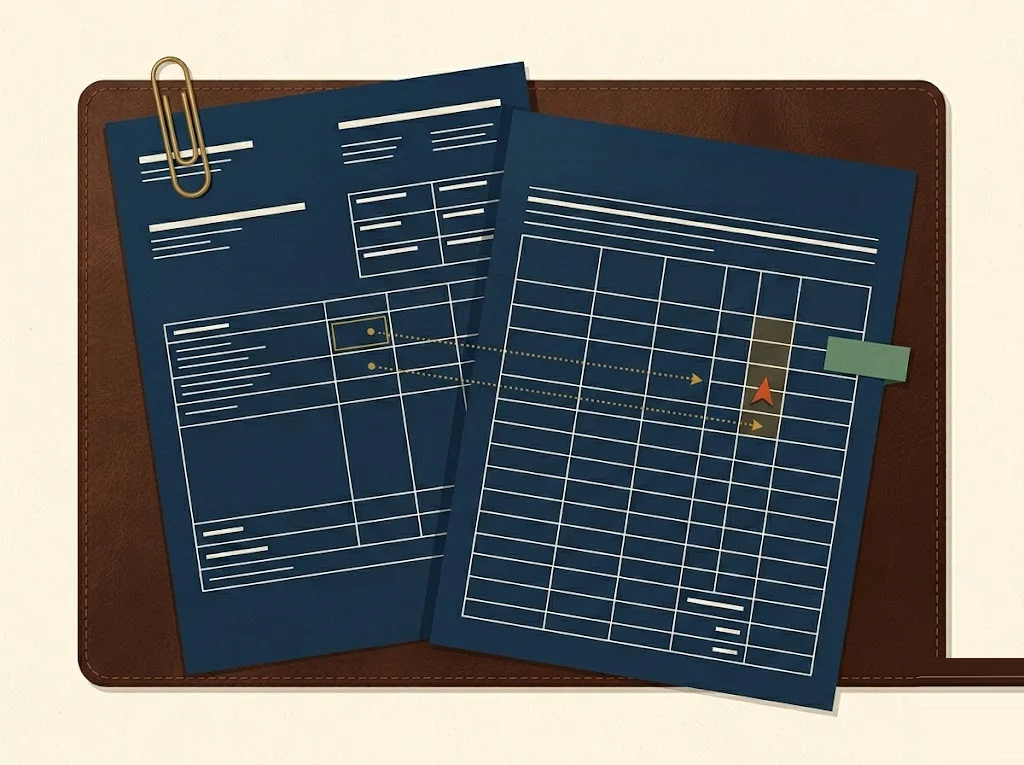
The short answer. Which Form 8949 category box your sale belongs in comes down to two questions the 1099-B already answers for you: was the security held one year or less (short term) or more than one year (long term), and did the broker report your cost basis to the IRS? Check box 12, “Basis reported to IRS,” and box 5, “Noncovered security,” and the answer falls out: covered short-term sales go in Box A, noncovered in Box B, long-term covered in Box D, noncovered in Box E, and anything never reported on a 1099-B in Box C or Box F.
Why the 1099-B is really a routing slip
A Form 1099-B reports the proceeds from broker transactions — your securities sales for the year. It is not, on its own, the form you file. Instead, each transaction it lists gets transcribed onto Form 8949, and the totals from Form 8949 then carry to Schedule D. So the 1099-B is best read as a routing slip: every figure on it is telling you where on Form 8949 a given lot is supposed to land. Get the routing right and the rest of the chain is mostly arithmetic.
The single most important thing the slip tells you is whether a security is covered or noncovered, because that distinction, paired with the holding period, is what assigns the category box. A covered security is one the broker is required to report cost basis to the IRS for — generally stock acquired for cash in an account after 2010, with later phase-in dates for mutual funds, dividend reinvestment plans, and certain bonds and options. A noncovered security is everything else, the classic example being pre-2011 stock. For a noncovered lot, the broker reports your proceeds but is not required to report your basis to the IRS, even though some brokers do supply it voluntarily as a courtesy.
How the broker signals covered vs noncovered
You do not have to guess. The 1099-B carries two checkboxes that resolve the question. Box 12 is labeled “Basis reported to IRS,” and it is checked when the cost basis was reported — that is the marker of a covered lot. Box 5, “Noncovered security,” is checked instead for a noncovered lot. The instructions even acknowledge how thin the data is on noncovered sales: when box 5 is checked, the broker does not have to complete boxes 1b, 1e, 1f, 1g, and 2. That is exactly why noncovered lots so often arrive with a blank or unreliable basis and a missing holding period — the broker was never obligated to fill those in.
So before you map anything, read those two boxes first. Box 12 checked means covered; box 5 checked means noncovered. Everything downstream depends on getting that one read right.
The other boxes you transcribe
Once you know the category, the remaining boxes are the raw numbers you copy across. It helps to know what each one means:
- Box 1a — Description of property. The name of what you sold.
- Box 1b — Date acquired, and Box 1c — Date sold or disposed. Together these set the holding period, which decides short term versus long term.
- Box 1d — Proceeds. The gross cash proceeds from the sale.
- Box 1e — Cost or other basis. Your adjusted basis, present on covered lots and often blank on noncovered ones.
- Box 1f — Accrued market discount, and Box 1g — Wash sale loss disallowed. Two figures that can force you to override what the broker reported; box 1g reflects a loss disallowed under Internal Revenue Code (IRC) section 1091.
- Box 2 — Short-term or long-term, determined under IRC section 1222, including an “Ordinary” checkbox flagging any portion treated as ordinary.
- Box 4 — Federal income tax withheld, which is backup withholding you will want credited.
When you fill in Form 8949, box 1d (proceeds) goes to column (d), and box 1e (cost basis) goes to column (e). That is the clean case, where the broker’s numbers are right and you simply copy them over.
The six category boxes, decided by two questions
Here is the full map. Part I of Form 8949 covers short-term transactions — those held one year or less — and Part II covers long-term transactions held more than one year. Within each part, the basis-reported status chooses the box:
- Box A — short-term, reported on a 1099-B with basis reported to the IRS (covered).
- Box B — short-term, reported on a 1099-B but basis not reported (noncovered).
- Box C — short-term, not reported to you on a 1099-B at all.
- Box D — long-term, reported on a 1099-B with basis reported (covered).
- Box E — long-term, reported on a 1099-B but basis not reported (noncovered).
- Box F — long-term, not reported on a 1099-B.
Read that grid against your two checkboxes and the assignment is mechanical. A covered lot you held eighteen months is Box D. A noncovered lot you held three months is Box B. A private sale that never generated a 1099-B and that you held two years is Box F. Sorting your transactions into these six buckets first — before touching any numbers — is the habit that keeps a long brokerage statement from turning into a guessing game.
When you override the broker, and where the codes live
The clean copy-the-numbers case is common but not universal. A few situations push you to override what the 1099-B shows, and they cluster on the noncovered side, which is exactly why covered-versus-noncovered matters so much. A wash sale flagged in box 1g, an incorrect or missing basis on a noncovered lot where you have to supply the real figure yourself, and accrued market discount in box 1f are the three you will meet most often. Box 1f shows up routinely for Treasury bills sold before maturity, where a day-count formula converts part of the gain into ordinary interest — that specific case is worked through in how an early T-bill sale is taxed.
In each case the correction does not erase the broker’s proceeds. Instead, you report column (d) and column (e) as before, then make the fix in column (f) — an adjustment code — alongside column (g), the dollar amount of the adjustment. The specific code letters and the rule for the sign of the column (g) amount are detailed on our dedicated page about the Form 8949 column (f) adjustment codes, so when you need a code, work from there rather than from memory. The wash-sale version of this override is also where careful planning pays off; if you are managing losses deliberately, see how the box 1g disallowance bites in tax-loss harvesting in a taxable account.
Where it all goes next
After Form 8949 is filled in, the totals flow to Schedule D: your short-term boxes feed the short-term section, and your long-term boxes feed the long-term section. One related figure reaches Schedule D by a different route entirely. Capital gain distributions reported in box 2a of Form 1099-DIV do not pass through Form 8949 at all; they go straight to Schedule D. If your year mixed dividend statements with brokerage sales, our explainer on how 1099-DIV box 1a, 1b, and 2a differ traces that separate path so you do not double-count or misplace it.
Keep the order in mind and the whole exercise stays calm: read box 12 and box 5 to settle covered versus noncovered, read the dates to settle short versus long, drop each lot into one of the six boxes, copy proceeds and basis across, and reach for the column-(f) page only when the broker’s numbers need correcting. That is the entire 1099-B-to-8949 mapping, and it is far closer to sorting mail than to doing math.
Quick answers
How do I tell whether my broker reported my cost basis to the IRS?
Look at box 12 on the Form 1099-B, labeled "Basis reported to IRS." When that box is checked, the lot is covered and your basis was reported, which points you to Box A (short term) or Box D (long term). When box 5, "Noncovered security," is checked instead, the basis was not reported and you land in Box B or Box E.
What is the difference between a covered and a noncovered security?
A covered security is one acquired after the applicable phase-in date (cash-purchased stock after 2010, with later dates for mutual funds, dividend reinvestment plans, and certain bonds and options) for which the broker is required to report cost basis to the IRS. A noncovered security, such as pre-2011 stock, has its proceeds reported but not its basis, although some brokers supply basis voluntarily.
Which Form 8949 box do I use if I never received a 1099-B for a sale?
Use Box C for a short-term transaction or Box F for a long-term transaction. Those two boxes exist precisely for sales that were not reported to you on a Form 1099-B at all.
My 1099-B shows the wrong cost basis on a noncovered lot. What do I do?
You report the proceeds the broker shows but supply the correct basis yourself, then record the difference as a column (f) and (g) adjustment on Form 8949. The specific adjustment code letter and the sign of the column (g) amount live on our dedicated column-(f) page, so route there for those mechanics.
Educational content only. finbarrow is an independent editorial publication, not a licensed financial advisor, broker, tax preparer, or attorney. Verify rates and terms with the issuer or relevant regulator. See disclaimers and funding disclosures.